Fee Collection & Online Payments
Raise demand for a whole class in one pass, collect over UPI, net banking and cards, and let receipts, ledgers and the day book write themselves.
For schools across India
Collect fees online, mark attendance in seconds, and publish board-ready report cards from a single student record. One cloud platform for admissions, academics, finance and parent communication — with no server to buy and nothing typed twice.
Last updated
Students
1,284
Attendance
94.2%
+1.8%
Collected
₹18.4L
+₹2.1L
Dues pending
₹3.2L
Fee collection
This term
Needs approval
An admissions register, a fee spreadsheet, an attendance diary and a report card template built in Word are four records of the same student, maintained by four people, that stop agreeing the moment anything changes.
What it costs you
None of this is anyone's fault. It is what happens when the same student exists in four places and no one of them is the one that counts.
A new admission is typed into the register, again into the fee sheet, and again into the attendance list. Every re-entry is a chance for the three to diverge, and they always do.
“What is outstanding in Class VIII?” or “who is below the attendance threshold?” should take a moment. Across separate registers it takes an afternoon, so nobody asks until they have to.
An absence, a due date, a published result — each reaches the parent through a note in a school bag, days after the fact, if it reaches them at all.
CampusTrue holds one student record that every module reads and writes. There is no second copy to reconcile, because there is no second copy.
Every school evaluates an ERP on the same three jobs. Each one below is a working module on a shared student record, not a separate product to license.
Set your fee structure once — heads, class-wise plans, concessions and due dates — and raise demand for the whole institution in a single pass. Parents pay over UPI, net banking or card from the app, and the payment posts to the student's ledger the moment it clears. Receipts are numbered, the day book closes itself each evening, and the settlement report matches gateway batches against what the bank actually credited.
Teachers mark the register on the phone already in their pocket, in under thirty seconds a period — the roll opens with everyone present, so only the exceptions are tapped. Parents of absent students hear the same morning rather than at the next parent meeting. The shortage report the examination office needs for eligibility is live every day of the term instead of compiled once, too late to act on.
Present
41
Absent
3
Late
1
Subject teachers enter marks for their own papers inside a window the examination office opens and closes, on any device. Totals, percentages, grades and ranks compute as marks land, so the tabulation register, the pass-fail statement and the report card are all views of one result and cannot disagree. Cards print on your board's own format and release to parents the moment results are signed off.
Result
Passed
Total
89.8%
Rank
4/48

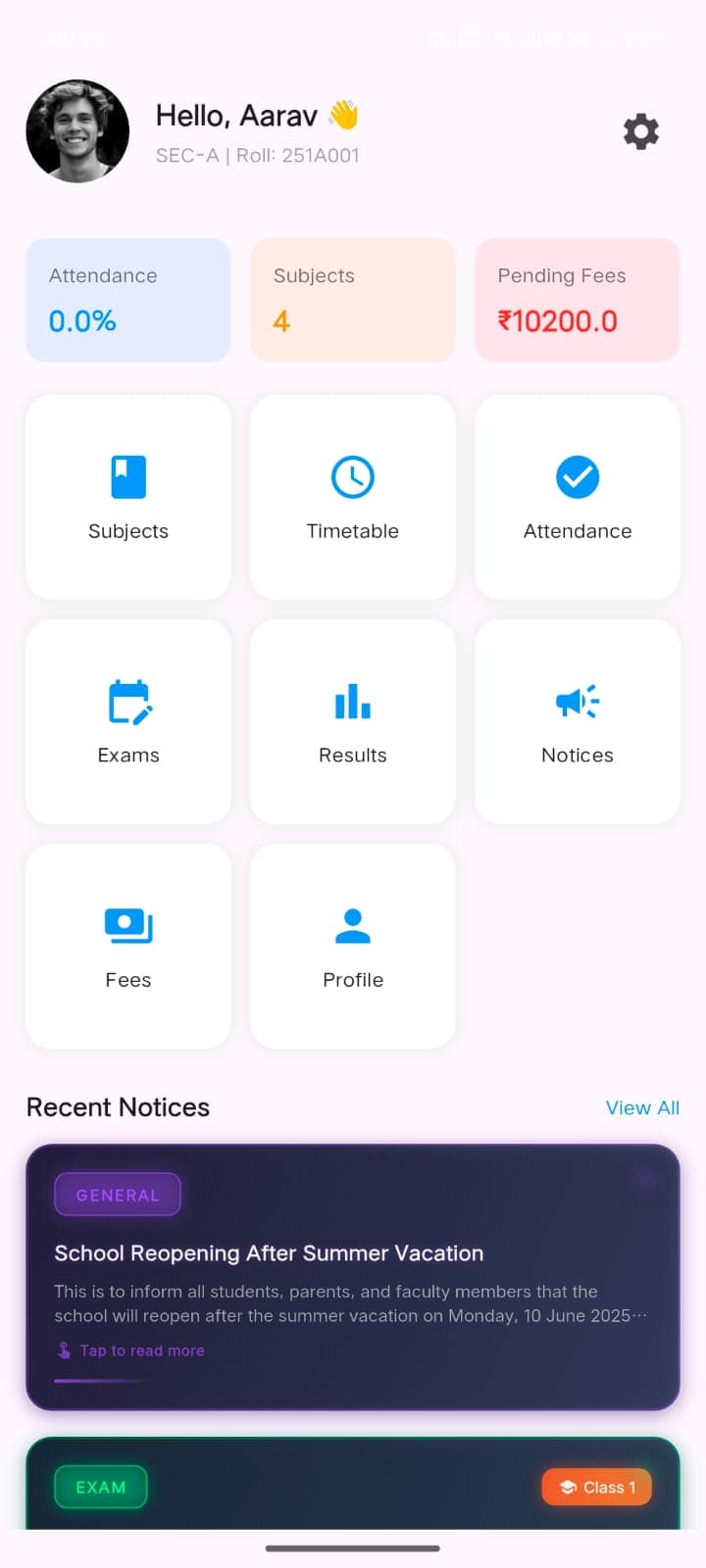
On the parent's phone
The screens a parent actually opens — attendance, fee balance and notices — cached so they load on a patchy connection rather than spinning on a loading state.
Where a parent has no smartphone at all, the same alerts go out as SMS in English or your regional language, so no family is left out of the loop because of coverage.
Roles
Parent, student, teacher
Platforms
iOS and Android
Offline
Cached key screens
Switch on what your institution needs today and add the rest when you are ready. Every module reads the same student record, so nothing has to be reconciled between them.
Raise demand for a whole class in one pass, collect over UPI, net banking and cards, and let receipts, ledgers and the day book write themselves.
Apply merit, means, sibling and staff-ward concessions against the fee structure itself, so a discount posts to the student's ledger as a recorded decision rather than a quiet edit to a bill.
Daily or period-wise marking from a phone that works offline, with same-day absence alerts to parents and live shortage reports for exam eligibility.
One marks entry produces grades, ranks, tabulation registers and report cards on your board's own format — CBSE, ICSE, state board or NEP 2020.
Enquiry to seat allotment online: application forms, document verification, merit lists and admission fee payment, all in one queue.
Generate admit cards for a whole class at once — photograph, roll number, examination schedule and centre — for parents to download, or printed in bulk for families without a smartphone. Unpaid-fee holds can apply automatically.
Print a whole cohort's identity cards from the photograph and roll number already held on the student record, on your institution's own design — a pupil admitted in July gets a card without a second data entry.
Generate a clash-free timetable from your own constraints, and cover an absent teacher with a substitute who is free and qualified for that period.
Circulars, fee reminders and absence alerts by SMS and in-app notification, in English or your regional language, so no family is left out.
Each role sees only what belongs to them, on screens cached to open on a weak connection rather than spin on a loading state.
Faculty profiles, workload distribution, leave balances and staff attendance on the same platform the academic day already runs on.
Routes, stages and bus rolls linked to the fee ledger and the attendance register, so a route change updates billing and marking at once.
Issue and return against the student record, with hostel block allotment, mess charges and room occupancy held alongside it.
Collection by head and class, attendance patterns, subject-wise performance and the exports a governing body meeting actually asks for.
Role-based access, an audit trail on every fee and mark entry, and student data held on AWS infrastructure inside India.
A fuller breakdown of every capability lives on the features page, and the mobile app page shows what each role sees on a phone.
Fees, attendance and results are the three things a school is held accountable for. The platform that holds them has to be answerable about where they live and who can see them.
Data residency
Student records never leave the country, with role-based access and an audit trail on every fee and mark entry.
Board coverage
Report card formats are configured per board, so a school running two boards prints each on its own template.
Support
Data migration from spreadsheets or an existing system is part of onboarding, not a paid extra quoted later.
Report card formats, parent communication and fee documentation differ by state. These pages set out what changes where.
Questions we are asked most often by principals, correspondents and administrators before moving an institution onto a platform. Anything not covered here, our team answers within 24 hours.
School ERP software is a single system that runs the administrative and academic work a school would otherwise spread across registers and spreadsheets — admissions, student records, fee collection, attendance, timetables, examinations and parent communication. The defining feature is that every module reads and writes the same student record, so a pupil admitted in July is on the July attendance register, billed from July, and sits the term examination on the roll the admission created, with nothing typed twice. The same category is sold as school management software or a school management system; the labels are interchangeable, and the distinction that decides whether it works is not the name but whether the modules share one student record or merely share one login.
Implementing CampusTrue school ERP software takes two to four weeks for a typical school. The work is mostly data migration and training rather than installation: your existing student records and outstanding fee balances are mapped to the CampusTrue record, loaded as a trial import that your office verifies against its own registers, and only then made live. Training runs as one session for office staff on admissions and fees and one for teaching staff on attendance and marks entry, with a follow-up once the first examination cycle has run.
Yes. Report card formats are configured as board profiles holding that board's grade bands, subject groupings, co-scholastic areas and printed layout, carrying your institution's name, logo and signatories. CBSE, ICSE and ISC, state board patterns and the NEP 2020 holistic progress card are supported, and a school running two boards across two wings prints each on its own template from a single marks entry.
Yes — CampusTrue is built to work on a slow or intermittent connection. The teacher app downloads each class roll ahead of the period and accepts attendance marking with no connection at all, queueing it locally and syncing when a signal returns. The screens parents open most — attendance, fee balance and notices — are cached so they load on a weak connection, and every alert also goes out as SMS so families without a smartphone receive the same information.
CampusTrue is quoted per institution rather than sold from a fixed table. The figure depends on your active student count, which modules you switch on, and whether data has to be migrated from an existing system. Request a demo and our team drafts a written commercial proposal within 24 working hours, with setup and training itemised in it.
Student data is held on AWS cloud infrastructure in Indian regions, so it does not leave the country. Access inside the platform is role-based — a teacher sees the classes they take, a parent sees only their own child, and office staff see the fee desk — and every fee transaction and mark entry is recorded against the user who made it, so corrections are auditable rather than silent.
Send us your institution type and student count. We will walk your team through fee collection, attendance and result processing on a configuration that looks like yours, and follow up with a written proposal.
No card details. A written proposal within 24 working hours.
Institutions outside these locations are supported remotely from our Bhubaneswar engineering office. Ask us about your state.